Newsweek Puts Obama on Cover as Hindu god Shiva "The Destroyer": "And I thought he was a Muslim!
In June 2009 Newsweek Editor Evan Thomas wondered if Obama was a 'sort of God.' Apparently Newsweek has decided that Obama is the Hindu god Shiva, described as 'the..."
Thursday, November 18, 2010


Figures! Anti-gun Zealot Nominated to Head ATF
Figures! Anti-gun Zealot Nominated to Head ATF: "

swenbwr "
"
RWB News: I know it’s hard to believe Obama is pushing for another Political Zealot(radical) to work with him in the White House.. Sarcasm
As Reported By The New American
Rather than wait for the new Congress to be installed in January, President Obama decided to press forward for the Senate confirmation of Andrew Traver for Director of the Bureau of Alcohol, Tobacco, Firearms and Explosives (ATF). As pro-Second Amendment scholar David Kopel pointed out, “The Second Amendment had a great night on [election day]. Across the nation, the right to arms is stronger than ever, and the stage has been set for constructive reforms in 2011. [In the] U.S. Senate: The net result of Tuesday was a gain of +6 votes on Second Amendment issues…. In not a single U.S. Senate seat did the gun control lobby gain ground.”
Traver was selected for the post back in August, but the announcement was made on Tuesday after the election results were finalized, and the day after the start of the 111th Congress’ lame-duck session. Traver joined the ATF as a special agent in Chicago in 1987 after a stint in the Navy, and has served as a special agent of the Chicago Field Division of the ATF since 2004.
The bureau’s history reaches back to 1886 where the agency was part of the U.S. Treasury Department, but grew substantial legs in 1968 after the Gun Control Act was passed. Following the 9/11 attacks, the ATF was transferred to the Justice Department, where it “regulates via licensing the sale, possession and transportation of firearms, ammunition and explosives in interstate commerce.” The bureau has a budget exceeding $1 billion annually and employs 5,000 including 2,400 special agents.
Special agents have the broadest authority of any federal agency, with the power to “enforce any statute in the United States Code. Specifically, ATF special agents have [the] lead investigative authority on any federal crime committed with a firearm,” and while the agency may cooperate with other federal agencies, it is free to operate independently of any of them.
Traver’s most obvious link to those opposed to Second Amendment rights is through his “Summit Membership” in the International Association of Chiefs of Police (IACP). Following their Great Lakes States Summit on Gun Violence in April of 2007, the IACP published its report “Taking a Stand: Reducing Gun Violence in Our Communities.” Included in its many recommendations were the following:
- Establish a “best practices” protocol for voluntary gun surrender programs
- Destroy all firearms that come into the possession of any law enforcement agency (even if such firearms were initially stolen and then recovered)
- Track and follow all private gun sales in a national data base with a mandatory background check on the purchaser
- Limit the sale of “multiple handguns”
- Mandate a “ballistic fingerprint” for every gun that is sold
- Require that every gun come with a lock
- Require that every owner provide for a federally regulated “safe storage” for his weapons, and “prosecute those who fail to comply with [those] safe storage laws.”
- Enact legislation “to allow federal health and safety oversight of the firearms industry.”
Most chillingly, recommendation #22 was: “The federal government should increase funding to the ATF for personnel and technical assistance to combat gun violence.”
Executive director for the National Rifle Association’s Institute for Legislative Action (NRA-ILA) Chris Cox investigated the IACP after their “summit” and discovered it had been funded by the left-wing Joyce Foundation.
That’s a familiar name to longtime readers. The Joyce Foundation has pumped tens of millions of dollars into the coffers of gun ban groups over the years. The Violence Policy Center (VPC), an unashamed promoter of a total ban on guns, collected more than $1 million of Joyce money….
The IACP newsletter proudly notes that the Joyce Foundation has made more than $30 million in grants to groups seeking public health solutions that offer the promise of reducing gun deaths and injuries in America.
Some of those beneficiaries of the Joyce Foundation include Mayors Against Illegal Guns Coalition, Handgun Epidemic Lowering Plan Network, the Indiana Partnership to Prevent Firearm Violence, the Legal Community Against Violence, and the Violence Policy Center.
With Traver’s public support of the IACP and his tacit acknowledgement of the funding behind it, it should be no surprise that President Obama has selected him to take the reins at the ATF.
swenbwr
"
The Lame Duck’s Seven Must Do Items
The Lame Duck’s Seven Must Do Items: "

While they were busy wasting time on Obamacare, energy taxes, and amnesty, the 111th Congress let many of their primary obligations slide. That is why the next two months is about to witness the busiest lame duck session in the history of Congress. Here are seven most do items this lame duck must address before the 112th Congress is sworn in:
1. Appropriations – Congress has yet to complete work on one of the 12 appropriations bills necessary to keep the discretionary budget of the government funded into next year. Congress is currently operating under a Continuing Resolution (CR) (PL 111-242)until December 3rd. A Continuing Resolution is a bill that funds the federal government under last years levels until it expires. Congress is going to have to decide between an Omnibus Spending bill, one that combines all of the 12 appropriations bills into one, or a Continuing Resolution that will fund the government into next year. Congressional Quarterly (subscription required) reports that it is unclear as to whether the Congress will try to pass an Omnibus or a CR.
Minority Leader Mitch McConnell (R-KY) said Tuesday that no decision had been reached on whether or how to proceed with an omnibus fiscal 2011 spending bill. Lawmakers will either need to put another stopgap spending bill in place or clear an omnibus measure before then if they want to avoid a government shutdown. Sen. McConnell said he had talked with Majority Leader Harry Reid (D-NV) about how to proceed, but that no decision had been made. “Harry and I talked yesterday and we just haven’t reached any conclusions,” McConnell said.
One emerging problem with the Omnibus is that is has been crafted without public participation with a $1.108 trillion price tag, a level too high for many Republicans. Also, the Omnibus is reported to include earmarks. This may be a problem because of the recent resolutions adopted by the House and Senate Republican caucuses to support a two year earmark moratorium.
2. Obama Tax Hikes – The big question for taxpayers is what is Congress going to do about the massive tax hikes scheduled for January 1st. Bloomberg reports that a summit between Republicans and Democrats scheduled for the White House today will not happen until November 30th.
A deal to extend soon-to-expire Bush-era tax cuts won’t be completed until December, and some Democrats in Congress said an accord may not be reached this year. Liberals are trying to “decouple” tax cuts for job creators, those making over $250,000/yr, the death tax, capital gains, and dividends from those with incomes of $250,000 or less. Bloomberg cited Clint Stretch of Deloitte Tax LLP who argued that allowing tax cuts to expire would “would add $2,600 annually to the tax burden of a median-income family earning about $70,000 a year.”
Conservatives want tax cuts to remain in place for all Americans. There are many proposals on the table right now. Sen. McConnell has submitted legislation to continue all of the tax cuts, Sen. Charles Schumer (D-NY) has promoted the idea of sustaining all of the tax cuts for those making less than $1 million, and Sen. Mark Warner (D-VA) favors the idea of steering tax cuts for job creators to business. There is a high probability that none of these legislative ideas will make it to the President’s desk. If so, expect taxes to increase for all Americans on January 1st 2011 and for the next Congress to have to deal with the issue.
3. Doc Fix – The rate that the federal government pays physicians who treat Medicare patients is scheduled to be cut 23% on December 1st. This cut is commonly referred to as “Doc Fix.” The Doc Fix issue may become another controversial expiring provision of law, because Congress is going to have difficulty finding money to offset the higher spending. According to Brian Blase of The Heritage Foundation a long term Doc Fix could prove very expensive using Congressional Budget Office and Centers for Medicare and Medicaid estimates:
Based on estimates from the Congressional Budget Office (CBO) and the Office of the Actuary at the Centers for Medicare and Medicaid Services (CMS), the 10-year cost of raising PCP rates to Medicare levels would be between $37 billion and $68 billion. The Heritage Foundation estimates that the 10-year cost could rise to $350 billion if state reimbursement rates were to rise proportionally for all physician and clinical services.
Republicans have been pushing for all new spending to be offset and a $20 billion offset for this program maybe impossible for big spending liberals to find.
4. Unemployment Insurance – Another expensive proposition for Congress is extending unemployment insurance that expires on December 1st. The idea on the table is to extend unemployment benefits for another 13 weeks. According to the Wall Street Journal (subscription required):
Congress is unlikely to agree to extend jobless benefits for two million unemployed workers by the time the program begins to lapse in two weeks, as lawmakers struggle with a packed lame-duck session and voter antipathy toward government spending.
Sen. Jim Bunning (R-KY) demanded earlier this year that a one month extension for unemployment benefits be offset with $10 billion in cuts to other programs. Both an extension of Doc Fix and unemployment insurance extensions may be part of negotiations for an Omnibus or a CR.
5. President’s Debt Commission – The President’s Deficit Commission is expected to submit a report to Congress pursuant to an executive order on December 1st. Both Speaker Nancy Pelosi (D-CA) and Majority Leader Harry Reid (D-NV) have promised a vote on the recommendations of the Commission in the lame duck. Conservatives are pushing back on any idea that takes “a 50/50 approach to eliminating the deficits and lowering the projected trajectory of the debt through tax increases and spending cuts.” It will be difficult to get this plan through Congress when many on the right and left are objecting to provisions in this bill that cut spending and increase taxes.
5. FAA - Other issues expiring are authorization for the Federal Aviation Administration that includes an increase in the Passenger Facility Charge (PFC).
6. TANF - A Temporary Assistance for Needy Families (TANF) emergency fund, a program funded through the stimulus plan, expired in September and many liberals in Congress want to keep the emergency fund authorized into 2011.
All of these issues will be front and center during the Lame Duck Congress and the American people will be sent a billion dollar bill if new programs are funded without cutting spending in other areas of government to pay for these Congressional priorities.
"Social Security Shortfall Is Real and Best Addressed Now
Social Security Shortfall Is Real and Best Addressed Now: "

Both liberals and conservatives agree that Social Security’s coming fiscal problems need to be addressed soon or they will only grow worse. A recent analysis for the Pew Charitable Trusts by Charles Blahous, one of the two public trustees of the Social Security and Medicare trust funds, and Robert Greenstein, executive director of the liberal Center on Budget and Policy Priorities, shows that Social Security’s problems cannot be wished away:
According to the trustees’ analysis, there is an 80 percent likelihood that the trust fund will be exhausted between 2032 and 2045. Moreover, under a scenario that is more optimistic than nine-tenths of likely outcomes, half of the projected 75-year actuarial imbalance would remain. Even under an extremely unlikely scenario, more optimistic than 97.5 percent of the possibilities, there would still be a fiscal shortfall of some amount.
What this amounts to is that “it is highly unlikely that the projected Social Security shortfall will disappear without legislative action.” Blahous and Greenstein further write that “the suggestion that simply maintaining [historical] patterns of productivity growth will sustain Social Security clearly is incorrect: to counter the effects of population aging, future real wage growth per worker would have to be much faster than in the past.”
Blahous and Greenstein rightly conclude that it is advantageous to restore Social Security to long-term solvency now, rather than wait. By 2015, Social Security will be spending more than the revenue it brings in. At that point, payment of promised benefits will be dependent on the Social Security Trust Fund. In 2037, however, the trust fund is projected to run out. If nothing is done by then, all seniors reliant on the program—regardless of age or other savings—will then experience a 22 percent across-the-board cut in benefits. Moreover, as Heritage Social Security expert David John writes, rather than see a stable reduction in benefits, seniors would receive a Social Security check only in months when payroll taxes covered the promised benefits in full:
If action is taken sooner rather than later, reform can be phased-in gradually, allowing future beneficiaries to adjust other savings and retirement plans to account for differences in Social Security’s promises. Moreover, acting now would put more options on the table and spread the effects over multiple generations. If Congress waits until the last minute, one generation will bear the brunt of saving Social Security, whether it is younger workers through a burdensome tax hike or retiring seniors through a severe last-minute benefit cut.
Also last week, the co-chairs of the President’s deficit commission released a report of possible deficit reduction strategies, and among their many suggestions was Social Security reform.
Regarding the co-chairs’ report, Heritage’s Alison Fraser writes:
The three major entitlement programs—Social Security, Medicare, and Medicaid—are the major driver of federal program spending. Reining in spending, and thus the deficit, is impossible without major changes to these programs. … The co-chairs are to be commended for addressing entitlements, since changes to these popular programs are necessary but politically difficult.
The co-chairs’ suggestions, though they could have gone further still, were a good start. Lawmakers must not delay in restoring solvency to Social Security. Unfortunately, some have instead come out in firm opposition to reform that would cuts seniors’ benefits in any way. Some have even claimed that Social Security does not face a shortfall and is in good condition. As the Blahous–Greenstein report clearly proves, this head-in-the-sand approach is both wrong and likely to make Social Security’s problems worse.
Lawmakers must ignore the politically charged rhetoric in support of leaving Social Security as is. If the program is to obtain stability and solvency, reform must take place now.
"Time to Clean Up the Medicare Doctor Payment Mess
Time to Clean Up the Medicare Doctor Payment Mess: "
Congressional Quarterly is reporting that the United States Senate is going to enact a one-month reprieve for Medicare physicians, saving them once again from a draconian reduction in Medicare payment.
This entire system is a mess. Under the existing Medicare payment formula (the Sustainable Growth Rate, or SGR) for doctors that the Senate and their House colleagues enacted in 1997, physician reimbursement is tied to the performance of the general economy. If in any given year Medicare physician payment outpaces the growth in the general economy, there is an automatic proportional reduction.
Routinely, Congress has blocked the annual payment reductions, but then, under the congressional formula, the payment reductions accumulate. Yet another flaw of the Patient Protection and Affordable Care Act is that it did not fix the physician payment problem. The result: This December, Medicare doctors will face a 23 percent cut in pay. A one-month extension of the reprieve would guarantee that the cuts next month would be even greater, requiring another congressional intervention.
No one on Capitol Hill, Republican or Democrat, wants the congressional formula to be operational. If Congress allowed a 23 percent cut to go into effect now, or a bigger payment cut to take effect later, it would certainly trigger a big—and bad—shakeup in the Medicare program, as more physicians would refuse to take Medicare patients, cut back on Medicare practice, or decide to take no more Medicare patients than they already have. It is not hard to imagine even more overcrowded hospital emergency rooms where senior and disabled citizens are desperately jostling with the uninsured and Medicaid patients to get medical treatments, even for non-urgent care. What a mess!
Congress should fix the Medicare payment system—but not add one dime to the deficit in doing it. It could do this by sequestering a portion of the projected $575 billion in Medicare savings they just enacted in the Patient Protection and Affordable Care Act to offset the additional costs—well over $200 billion in 10 years. Congress should also extend the fix for longer than one month and require that Congress enact a permanent fix to this problem during this temporary fix.
To permanently fix the problem, Congress should provide for a predictable and stable payment increase (perhaps based on inflation as measured by the consumer price index) but allow doctors to charge extra over and above the Medicare reimbursement levels. This would return physician payment practice to the standard that existed in Medicare prior to 1989.
Congress should also allow doctors and patients to go outside of the Medicare program and contract privately for Medicare services without statutory or regulatory obstacles. There was no statutory restriction on this practice until 1997, when the Balanced Budget Act provided for a bizarre statutory restriction on Medicare private contracting (Section 4507 of the Balanced Budget Act), plus the flawed Medicare physician payment update, which no Member of Congress wants to enforce.
Congress should admit that its Medicare administrative payment process is outdated. Through the Medicare bureaucracy, Congress sets the prices of over 7,000 medical procedures, slaps on a price control regime, and then threatens the imposition of a formula that has little to do with the real market conditions of supply and demand. Routinely, they overpay or underpay doctors and hospitals because of their system of central planning and price regulation. Liberal and conservative analysts alike agree that they can’t get the medical prices exactly right.
The right answer is to reform the Medicare program itself. A good place to start is the model suggested recently by the Bipartisan Task Force. Or, better yet, the more refined Medicare proposal recently presented by former Congressional Budget Office Director Alice Rivlin and Representative Paul Ryan: Replace the existing Medicare financing system with a premium support system broadly similar to that which exists in the Federal Employees Health Benefits Program (FEHBP). In the FEHBP, Congress doesn’t have to worry about anything like the Medicare RBRVS, DRGs, or the dreadful SGR. Physician payment is handled very nicely in the market. Better still, Congress doesn’t have to perpetually embarrass itself with its periodic Chinese fire drill to stave off Medicare payment crises.
"The Ruling Class Doesn’t Like Paying Taxes, Either
The Ruling Class Doesn’t Like Paying Taxes, Either: "
Government employees owe $3.3 billion in back taxes, CNBC reports.
According to Heritage Foundation fellow James Sherk, the typical federal worker “receives 22 percent more in wages than an equally skilled private sector worker … .” And, says Sherk, when both wages and benefits are toted up, federal workers are overpayed by $40 billion to $50 billion per year.
You’d think they would be able to pay their taxes.
"Boehner: GOP will move 'quickly enough' to repeal healthcare law
Boehner: GOP will move 'quickly enough' to repeal healthcare law: "
“We think that Obamacare ruined the best healthcare in the country, we believe it will bankrupt our nation,' Boehner said.
US still on hook for $27 Billion with GM stock sale
US still on hook for $27 Billion with GM stock sale: "

In addition to what legitimate creditors lost when Obama illegally gave ownership shares to the auto workers union, the GM stock sale being propagandized as a success still leaves US taxpayers holding the empty bag.
By Michael Whipple, Editor
We hear that all is is going great with the GM stock offering. Few are mentioning the theft of assets from the original creditors, the union pension bailout at taxpayer expense or the billions in funds that may never get repaid. We won’t even go into the constitutionality of the government taking over a private company, overturning decades of surety laws, and paying campaign supporters with confiscated stock.
The Wall Street Journal points out that this is not near as good as was anticipated;
“So, today, amid the bally and the hoo, many have lost track of that fact. The offering valued GM at $50 billion, the low end of the hoped-for range. You would never know it, based on everything you read and hear. Once underwriters saw where demand was (not as great as desired), they shifted from talking about implied valuation to emphasizing shares issued, the per-share price and total money raised. The different storyline painted a picture of boffo box office even though the facts, as laid out just a few weeks ago, indicate that this deal really didn’t meet the hopes and expectations of GM or its biggest shareholder, the U.S. Government.”
So even though all the media hype is pushing Obama’s mantra of what a great thing it was to destroy the constitution in taking over the auto industry, the US is still short $27 billion. Obama says “it helped save jobs, rescue an industry at the heart of America’s manufacturing sector and position it to be more competitive in the future.” according to the Washington Post.
CNNMoney.com reports that:
“But even with that stock sale and other money returned to the government by GM, about $27 billion will remain unpaid.”
An earlier IBD Editorial pointed out the sweetheart deal Obama gave the UAW:
“Given that the wasteful work rules that UAW bosses — wielding government-granted monopoly-bargaining power over employees — insisted on for decades were largely what drove GM into bankruptcy, they certainly didn’t deserve kid-gloves treatment. Yet that’s what they got.
A UAW-controlled auto retiree health care fund was owed $20 billion by GM before the bailout.
Under the White House-dictated terms, UAW-appointed fund managers got back half of what they were owed in cash, whereas taxpayers who were owed $19.4 billion didn’t get a dime back in cash.
Instead, the Obama administration “forgave” this entire loan on taxpayers’ behalf and earmarked an additional $23.5 billion for the company’s trip through bankruptcy. In exchange for the nearly $43 billion funneled to GM, taxpayers acquired a “60.8% equity stake” in GM.”
It should be noted that the UAW is one of the most politically active of all unions. The union gave $2,119.937 to the 2008 campaigns 99% of which went to Obama and the Democrats. They gave another $1,106,500 in this past 2010 election cycle 100% of which went to Democrats. That is a total of $3,226,437 in just the last two election cycles. That does not include the phone banks, neighborhood canvassing and get out the vote efforts. Since 1990 the UAW has donated $26,510,252 of which 99% went to Democrats.
Not a bad return on investment when you consider they received billions back in ownership and benefit funding.
Taxpayers still have some stock but the price will have to rise 65% to get our money back. Not much chance of that happening even when the government is subsidizing purchases of the GM Volt to the tune of $7,500 each. By the way that $7,500 is being supplied by you the taxpayer and is not being considered in the overall loss figures on the GM union payoff scam.
The UAW also spends about a million and a half a year lobbying for important issues like card check, pension bailouts and the Buy America Act. So in reality taxpayer money was used to pay off unions so that they could then campaign for Democrats and lobby for special favors from those same Democrats. This is change alright. An increase in arrogant corruption that is off the Richter scale.
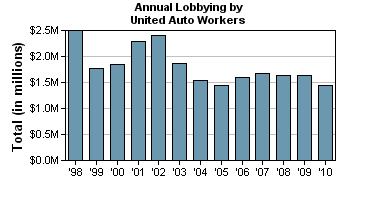
From Open Secrets.org Center for Responsive Politics
And barely a peep is being made about the $248 million in estimated fees being paid to the IPO underwriters including Goldman Sachs, Morgan Stanley, JP Morgan Chase, Bank of America, Citigroup, Barclays, Credit Suisse Group, Deutsche Bank, and Royal Bank of Canada.
As another bonus for Obama who is the all time highest recipient of contributions from Goldman Sachs related donors, Goldman gets a payoff from the union payoff.
Isn’t America great!
RELATED ARTICLES:
GM uses taxpayer dollars to donate to Democrats and leftist groups
Gov’t Motors’ Electric Edsel
Krauthammer: “The Chevy Volt Is A Disaster”
SEIU union spends $500,000 in local election, may reach $1,000,000 – a sign of the times?
In the Tank for Big Labor
The Unionized States of America
Taxpayer losses from bailing out Chrysler and General Motors may reach $34 billion
Union benefits already bailed out with taxpayer dollars in GM deal
Was White House pushing Toyota witch hunt to pump up GM, Chrysler?
Public sector unions collapsing East St. Louis
Cititzens wise up to high union costs
Unions plan to own your representative – step up the election heat
More union disclosure woes
The best government money can buy -top 20 public sector union paid politicians
Violent leftists – Union Thugs Attack Non-Union Workers with Baseball Bats
Bankruptcy by union extortion – its spreading
Unions out bid big oil for influence with Democrats
No wonder unions will spend over $100 MILLION to keep Democrats in power
Myths about the teacher layoff crisis
Democrats in Congress Want To Bail Out Union Pensions
Unions using your tax dollars to campaign against you
Big Labor’s Payoff ( one of many)
Look who’s protecting incumbents
Union style terrorism ok when bankers are target?
Unions to spend $100 MILLION+ on saving Democrats -will want even more payback
Taxpayer losses from bailing out Chrysler and General Motors may reach $34 billion
Union benefits already bailed out with taxpayer dollars in GM deal
Tide of PR battle turns against public employee unions
NJ Gov. Christie has the ‘tone’ the people want to hear
Another big union payoff without congress
Another big union payback for Obama election help
Warning! Card check isn’t dead
Obama Gives Unions a ‘Massive Payback’ with Executive Order, Contractors Claim
Fix Is On by Obama and Congress in Union Fight
Meet Andy Stern -SEIU President and Close Obama Ally – & learn about union influence
“New Jersey is the failed experiment”
NJ Governor Christie takes on the Teachers Union
Why firing the desk-sleepers, burnouts, hotheads and other failed union teachers is all but impossible
Socialists and American Unions
Unions want to dump pensions on taxpayers
Public-sector unions bleed taxpayers
Unions Making Postal Service Unsustainable, GAO Says
Labor unions put heat on Democrats – Seek passing of ‘ card check’ and other political payoffs
Obama payoff to unions now official – only unions get government contracts
California At The Breaking Point
Stern Exit May Make Big Labor More Powerful
SEIU pushes immigration ‘reform’ for 8 million new ‘progressive’ voters by claiming opposition is “so f**ing rabidly racist”
Obama and the Dems’ Payoffs to Big Labor continue
Pro union Specter wins state AFL-CIO backing
Unions want Washington’s help (your money) with pension funds
Jerry Brown colludes with unions -urges them to “attack”
Obama thanks SEIU for campaign help & touts public healthcare
New report exposes ACORN as partisan campaigner with ties to SEIU
Sinking By The Stern – Union Influence
Public Sector Unions Tarnish the Golden State
White house to reveal new ’screw the taxpayer, reward the unions’ contracting rules
Public Sector Unions and their Political Donations
Hop on board the public employee union special -unions bankrupting cities & states -will US pick up the tab?
White House to push ACORN pet project- Critics warn plan will ’sneak socialism’ into U.S., cause major economic loss
Obama caught lying about ACORN involvement -where is the investigation?
Why firing the desk-sleepers, burnouts, hotheads and other failed union teachers is all but impossible
Obama’s Love of Labor Makes for One Unholy Union
Public sector: An anchor as we sink
California is America’s Greece
Public Unions Bring LA Near Bankruptcy
Obama and the Government Employees Unions
Money For Nothing- More Union Payoffs with YOUR Money
Dumb and Dumber? What Are College Kids Learning About Our Country?
Big Union money secretly influencing state elections in US
Government Unions Win, You Lose
"People fleeing forced-unionization, high-tax states and moving to right-to-work, low-tax states
People fleeing forced-unionization, high-tax states and moving to right-to-work, low-tax states: "There's more to the story than this headline suggests: Low-tax states will gain seats, high-tax states will lose them. This is what's called 'voting with your feet.' And Michigan is one of the losers. Because of the population exodus from this state, we are slated to lose 1 of our 15 US Representatives. And we're not alone:
 What do you think it would look like for Wayne County, MI? Uh - like this:
 More from Sister Toldjah. HT: memeorandum
Previously:
One graphic that illustrates just how screwed Detroit is
The Michigan Exodus, Part 6 - The Acceleration
Liberal Utopia Michigan Loses Population For 4th Straight Year, Now Under 10 Million
Ohio Contracts Michigandus Exodusius
The Symptom of a Problem in Urban Cities
The Michigan Exodus, Part 5
The Michigan Exodus, Part 4
The Michigan Exodus, Part 3
The Michigan Exodus, Part Deux
Granholm Pushing Tax Amendment While Michigan Exodus Continues
The Michigan Exodus "
"
See that the states that are gaining seats are by and large red states, with Texas leading the way:Migration from high-tax states to states with lower taxes and less government spending will dramatically alter the composition of future Congresses, according to a study by Americans for Tax Reform

Eight states are projected to gain at least one congressional seat under reapportionment following the 2010 Census: Texas (four seats), Florida (two seats), Arizona, Georgia, Nevada, South Carolina, Utah and Washington (one seat each). Their average top state personal income tax rate: 2.8 percent.And now for the losers that are by and large blue states, including us:
By contrast, New York and Ohio are likely to lose two seats each, while Illinois, Iowa, Louisiana, Massachusetts, Michigan, Missouri, New Jersey, and Pennsylvania will be down one apiece. The average top state personal income tax rate in these loser states: 6.05 percent.Per capita government spending is lower in the winner states ($4,008) than the losers ( $5,117). Shocker, eh? But it's not just taxes and government spending. It's unions:
...“in eight of ten losers, workers can be forced to join a union as a condition of employment. In 7 of the 8 gainers, workers are given a choice whether to join or contribute financially to a union.”Someone tell me again how forced-unionization is constitutional? Since the GOP controls all branches of government here in Michigan, it's high time that we made this state a right-to-work one. The above is totally in line with this post from the summer: One graphic that illustrates just how screwed Detroit is. Here is what the graphic looks like for Travis County, Texas (black is a gain, red is a loss):


Previously:
One graphic that illustrates just how screwed Detroit is
The Michigan Exodus, Part 6 - The Acceleration
Liberal Utopia Michigan Loses Population For 4th Straight Year, Now Under 10 Million
Ohio Contracts Michigandus Exodusius
The Symptom of a Problem in Urban Cities
The Michigan Exodus, Part 5
The Michigan Exodus, Part 4
The Michigan Exodus, Part 3
The Michigan Exodus, Part Deux
Granholm Pushing Tax Amendment While Michigan Exodus Continues
The Michigan Exodus
Subscribe to:
Posts (Atom)